In case you missed it, and it was easy enough to miss, Baltimore City’s Mayor Brendan Scott approved Ordinance 26-094 on March 9, 2026. This Ordinance applies to security companies who employ guards in Baltimore City. In short, it requires that Baltimore City security guards be paid a prevailing wage. But let’s look a little closer at the details.
First, it is important to know that the ordinance is structured in three phases. Phase 1 is currently in effect through the end of 2026; Phase 2 goes into effect on January 1, 2027, and remains in effect through the end of 2031; and Phase 3 goes into effect on January 1, 2032, and remains in effect thereafter. There are a few differences between the phases, but the meat of the ordinance remains the same: a covered security employer must pay a covered security guard a minimum compensation. We will be focusing primarily on Phase 1 for now.
Who Does the Ordinance Cover?
Your first question is likely, do I have to care about this ordinance? The odds are, you do. Let’s take a look at the terms of the ordinance:
- What is a covered security employer. This is defined as any person, firm, LLC, corporation, or public entity (or subsidiary/department) employing 2 or more covered security guards, or self-employed guards, on a proprietary or contractual basis within the City. 2 or more. Unless you will never have more than a single guard anywhere in Baltimore City, you are covered by the entity.
- What is a covered security guard? Don’t worry, the ordinance defines that, too: an individual employed in Baltimore City by a covered security employer who principally protects individuals or property from harm/theft; deters, observes, detects, or reports incidents to prevent unlawful activity; or responds to a triggered security-system alarm. With the sole exclusions of marine guards/ship watchmen and unarmed employees of a bar, tavern, or restaurant, anyone doing any sort of security work is a covered guard.
These definitions tell us that if you are a security firm that handles any work in Baltimore City, you will need to pay those Baltimore City guards the minimum compensation. And what is the minimum compensation? I’m glad you asked.
What Does the Ordinance Set as Minimum Wage?
Well, that’s where it starts getting a little complicated. The method used to determine what minimum compensation is changes depending on the phase. For now, we will only be discussing the calculation currently in use, in Phase 1.
The ordinance’s calculation of minimum compensation means no less than the combined value of the minimum wage rate, health and welfare rate, and paid vacation and holidays rates of the locality wage for a Guard 1 classification established by the United States Secretary of Labor. If you already know all about locality wage determinations, feel free to skip down to the next paragraph. For everyone else, all you need to know is a law called the Service Contract Labor Standards (“SCLS”) directs the Secretary of Labor to set a federal minimum wage for specific categories of jobs, and those rates are different depending on the geographic location. So, someone working a job under the SCLS in Omaha has to be paid a different amount than someone working the same job in Maryland.
Now let’s break down what’s going into the combined value the ordinance describes:
- Health and Welfare Rate—The employer needs to provide either actual healthcare benefits in the form of an employer-sponsored health plan or paid health reimbursements, or the employer must provide monetary equivalent of those benefits as supplemental wages.
- Paid Vacation and Holidays Rates—The employer needs to provide a set minimum of paid vacation and federal holidays, or the employer must provide the monetary equivalent of those vacation days and holidays as supplemental wages.
With all that cleared up, the calculation is pretty straightforward:
The SCLS minimum wage for a Guard 1 in Maryland
+
The value of the minimum required health and welfare rate
+
The minimum paid vacation days and holidays
=
The minimum required compensation.
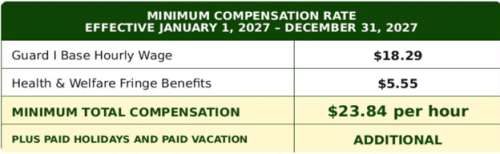
But who wants to do that math? Fortunately, the ordinance also requires Baltimore City’s Office of Equity and Civil Rights’ Wage Commission to do that for you. The ordinance also requires the post the actual minimum compensation no later than July 1 each calendar on their website, Wage Protection Resources | Baltimore City. It is titled Security Guard Compensation Notice, and is in the image featured at the top of this post.
As you can see, the July 1 calculation becomes effective the entire following calendar year. That means, even though Phase 1 only lasts until the end of 2026, the Wage Commission’s calculation is in effect through the end of 2027.
Phase 2 Requirements
If you are still with me, you are probably asking, if the Phase 1 calculation is still in effect until the end of 2027, what do I care about Phase 2, which goes into effect on January 1, 2027? There are two crucial things Phase 2 adds:
- The enforcement provision. Until January 1, 2027, the ordinance is informational, giving covered employers time to put the necessary processes in place. Come January 1, 2027, not paying the minimum compensation will be considered a violation of Maryland minimum wage laws.
- The requirement to display the notice. As of January 1, 2027, covered employers will need to post the Wage Commission’s Notice with all other required workers’ rights notices.
So, speak with your payroll department (even if that’s just you wearing another hat), mark your calendars, and get ready to experience the joys of dealing with a prevailing wage. And if you found this absolutely riveting, be sure to tune in next year when we discuss the ways Phase 2 changes the calculation.
Luchansky Law helps employers stay compliant with federal, state, and local laws. We would welcome the opportunity to help you with a handbook/policy review or manager training tailored to your workforce. Call us today at 410.522.1020, or email me at alan@luchanskylaw.com.